Unpublished draft. This page has not been approved and the artifact it points at has never been announced. Review items are at /notes.

A music box that is bad at your song.

It won't finish your tune the first time. Come back tomorrow and it will be better at it.

Open the box

Free. One file. Works offline. Nothing is asked of you.

The Tin Ear music box with its lid open, ten brass tines above a punched paper strip, and a pencil note reading ‘again.’
The lid open after a first play. Twenty-one holes on the strip, and the pencil has already written once.

Every other music box plays your tune correctly

There are a lot of music box toys on the internet. Punch your holes, press play, hear your tune, exactly as punched, forever. That is the entire product in all of them, and it is why none are interesting after the second play. A machine that does exactly what you told it has nothing to say.

This one has a tin ear.

The first crank

You get a strip of paper and twenty-four steps of blank grid, ten tines tall. You punch holes where you want notes. Fourteen holes is plenty. If you have a tune in your head, punch that.

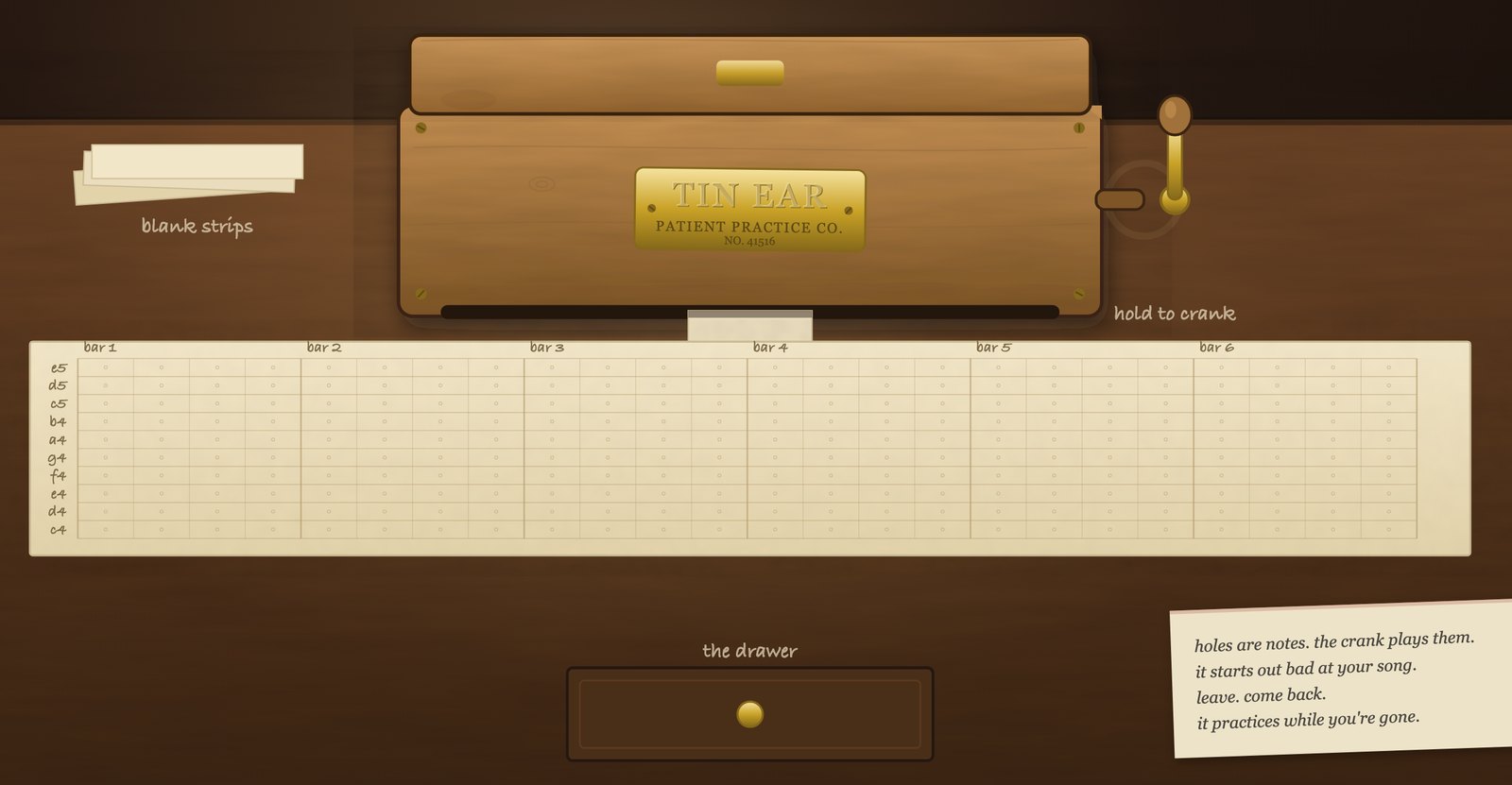
An empty Tin Ear bench: a blank twenty-four step grid labelled bar 1 to bar 6, a pile of blank strips, and a drawer.
The bench before anything. Six bars, ten tines, a pile of blank strips and a drawer.

Then you hold the crank down, because playing something should cost you a little.

It starts fine. Four or five notes in it slows down slightly, the way a person slows down before a bar they know is hard. Then it plucks the wrong tine, mid-phrase, and stops. Not a crash. It stops the way you stop when you hear yourself.

In pencil, on the case, it writes:

again.

The paper backs up two pulls. It takes the same bar from the start, slower than before, and settles into it. It lands the note it missed.

Then it slows to a stop, the way a wind-up thing runs down.

It does not finish your song. Not the first time. That is written into the code as a scripted ritual, the same for everybody, and it is the only thing in the whole machine that is not left to chance.

Then you leave

Here is the part that is strange.

Close the tab. Go do something else. The box practices while you are gone: one full run-through of your strip for every two and a half minutes of real elapsed time.

Be clear about what that is. Nothing runs while the tab is closed. There is no server and no background process. The box writes down the time when you leave, reads the clock when you come back, divides, and credits itself the runs. The practice is arithmetic.

It is still the honest version of the thing, because the arithmetic is not a decoration. The number it works out feeds a curve that governs how often it misses, how much it hesitates, and which bar it is still fighting. Two hundred practices is a real difference you can hear against zero. Nobody is pretending a small machine sat in the dark going over your song. It kept the time, which is what a music box is for.

Eight hours away is a hundred and ninety-two practices.

Three days is one thousand seven hundred and twenty-eight.

When you open the lid, it tells you the number, and then it plays your song better than it played it when you left. Not fixed. Better.

The curve is slow on purpose. One night takes the worst of it off. A week gets most of the wrong notes out. Full mastery of a hard strip is about a month of real time, and there is still something to hear after that, which is why it was built slow.

The pencil reports it like a night-shift log:

192 practices in the dark. the notes are the same in the dark.

1,728 practices. the hard part moved to bar 4.

There is no streak. There is no notification. Nothing decays if you stay away, and nothing is waiting for you in a way that expects anything. Time away is only ever practice time. The box has one job while you are gone and it does it.

Around practice one hundred and fifty, it makes a decision. More on that below.

What it writes

The pencil is the box's whole vocabulary. It writes in lowercase, on the case, in a hand that scratches faintly if your speakers are on.

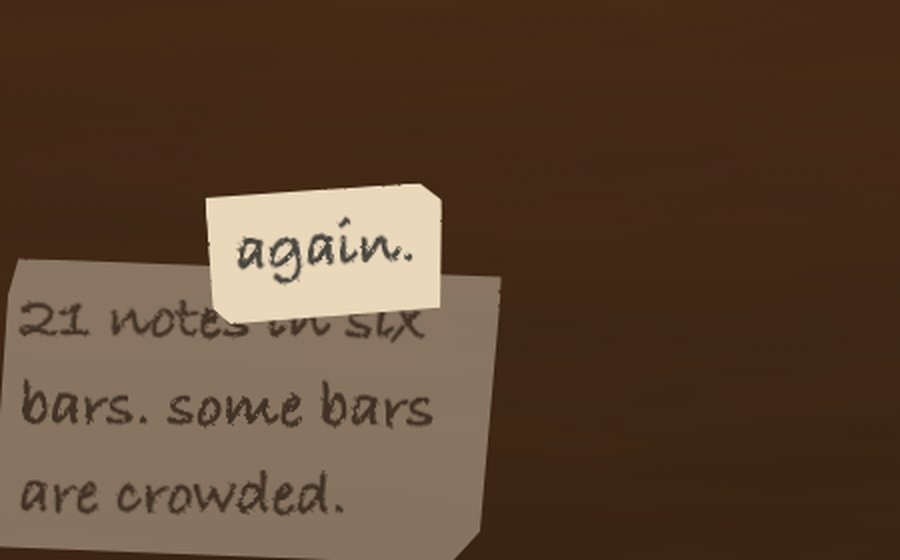
Two pencil notes on the workbench. The newer reads ‘again.’ The older, fading underneath, reads ‘21 notes in six bars. some bars are crowded.’
Two notes from one session. The older one fades as the newer one lands.

It never says it is proud of you, and never says the song is beautiful. What it does is report what happened, and the reporting is what makes it feel like something is in there:

wrong tine. i heard it too.

we both heard that.

the paper said f. the comb said g. the paper wins.

fewer wrong notes each run. not zero. fewer.

Two hundred and thirty-two of these were written. Fifty-eight were killed by a pair of filters built to enforce five rules, one of which was that any line you could imagine hanging in an office kitchen dies. What survived reports behaviour and never feeling. It says “i kept it.” It does not say “i love it.”

Everything the pencil claims is mechanically true. If it says it practiced two hundred and twelve times, the counter says two hundred and twelve. The box does not have a compliment in it, and it cannot lie about arithmetic.

Go punch a tune

Fourteen holes. Two minutes. Nothing to sign up for. You can read the rest of this after.

How it is wrong

Being bad at something is easy to fake and hard to make listenable. Most of the build went here.

The comb has ten tines, all in C major. When the box misses, it does not play a random frequency. It plucks a neighbouring tine, one step up or down the scale, sixty percent of the time too high. Every wrong note is in key. You hear the mistake as a mistake and not as a bug, because a bug is out of tune and a struggling player is merely wrong.

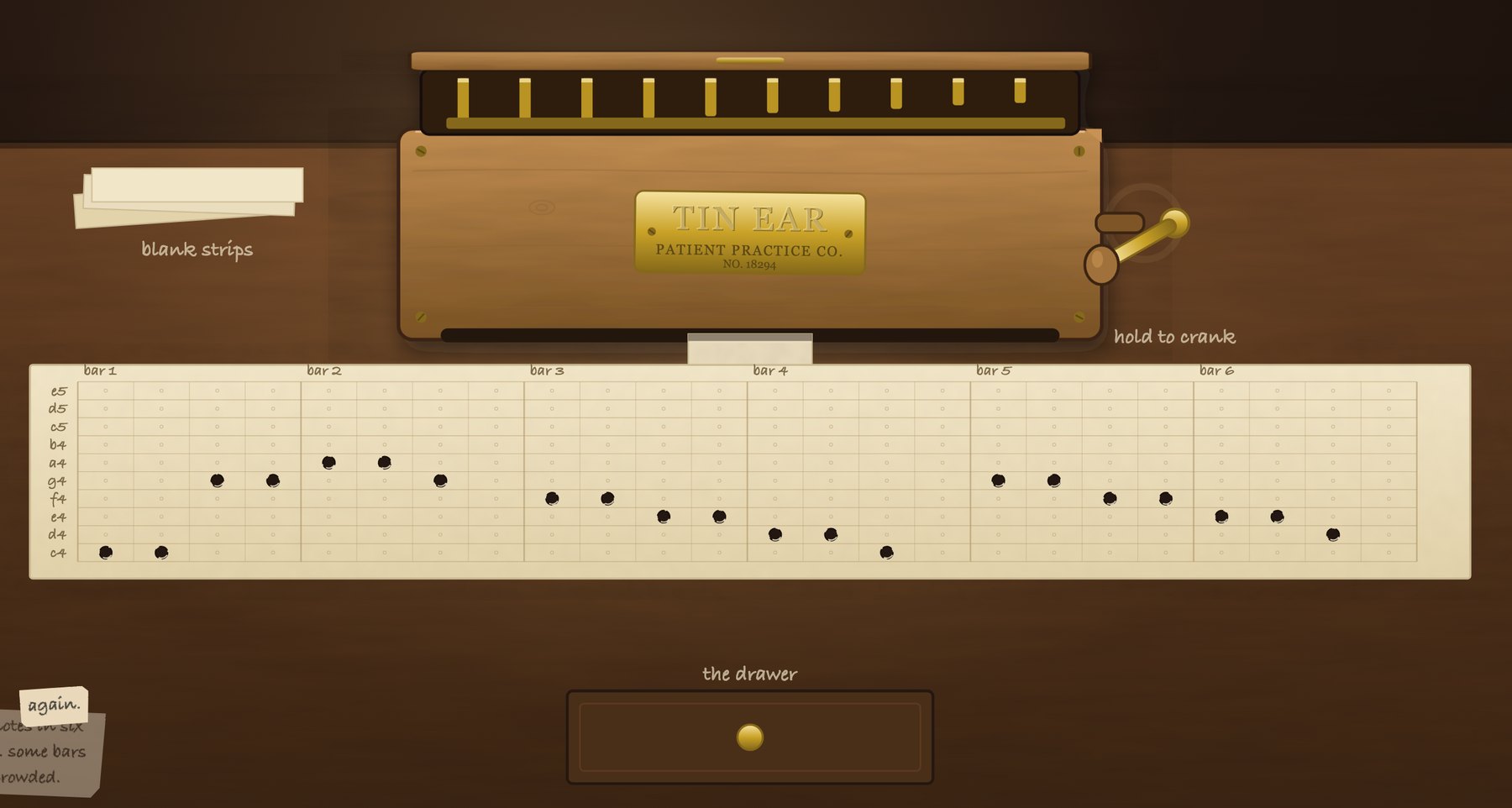
A punched paper strip, twenty-one holes across six bars, from e5 down to c4.
Twenty-one holes across six bars. Bar 4 is the crowded one, which is the one it will fight.

Wrong notes come out quieter, at seven tenths the volume of a right one. That single number does most of the emotional work in the machine. A malfunction plays wrong notes at full confidence. Something that knows it is wrong pulls back.

The hesitation carries the rest. Before a big interval, or a bar with a lot of holes in it, the box slows down by a third. It slows before the hard part, not during it, which means it knows where the hard part is. Anticipation is the difference between struggling and malfunctioning. After a bad note it drags the next one slightly, which is what shame does to tempo.

Underneath, each tine is four inharmonic partials at ratios of one, 4.06, 9.63 and 16.7, run through a generated impulse response so the case has a room in it. Every tine carries small fixed flaws, seeded once from a string in the source and therefore identical on every copy of the file in the world. Tine seven is three and a half cents flat. It is flat on your machine, it is flat on mine, and it will be flat in ten years.

One more thing that took real care. Punch a new hole into a song the box already knows and that note is young: its reliability grows from the moment you added it, not from the strip's birthday. A mastered tune with a fresh note in it wobbles in exactly one place.

And every performance is seeded by your strip and the practice count, so reloading the page mid-visit replays the same rendition, wrong notes and all. A handmade object does not reshuffle its imperfections while you are looking at it.

It gets worse before it gets better

Between practice fifty-five and seventy-five, the box is worse at your song than it was at fifty. Error rates go up by a third and then come back down.

Nobody had to build that. Someone typed a 1.3 into a file so that a machine would have a bad week.

Then, at one hundred and fifty, it stops trying

At practice one hundred and fifty the box picks one note it has been getting wrong and stops working on it. From then on it plays that note one tine off, on purpose, at full volume, forever. And it tells you:

i gave the f in bar 2 every chance. it's g now.

Full volume matters. Every other wrong note is played at seven tenths. This one comes out at slightly more than one, because it is not an error anymore.

Flag it again later and it will hold its position:

the g has seniority in bar 2 now.

the g lands the same every run. mistakes don't do that.

Get the rest of the song perfect and it will still write:

no wrong notes today. except the one that isn't wrong.

A machine that has been given a specification, has tried to meet it several hundred times, and has quietly decided it prefers its own version, is a strange thing to find inside a hundred kilobytes of HTML.

The rules it lives by

These were written before the pencil lines were, and enforced by filters that killed a quarter of them:

The box never praises you. It never asks for anything. It never guilt-trips.

Your absence is only ever practice time, stated as plain fact. Never loss. Never longing.

It reports behaviour, not feelings. “i kept it,” never “i love it.” The one exception is understated taste, because taste is where personality shows.

Everything the pencil claims must be mechanically true.

If a line could hang in an office kitchen, it dies.

The point of writing them down was to make one thing structurally impossible: the sentence where a small machine tells you that you are enough. It is one template slot away from saying it at all times, and it never does.

It is not one of those

Somewhere in the last few sections you may have filed this under talking software that keeps you company. It is worth being specific about why it is not.

There is no chat. It cannot be addressed and it does not answer questions. It has no model in it and no connection to one: the pencil draws from ninety-eight fixed lines, written by hand, sorted into twenty situations, picked by a seeded function with the numbers filled in from counters. Every one of them was argued over, and a quarter of the candidates were thrown out before the list was cut again.

It is finite. If you use it long enough you will see a line twice, and the person who built it would rather you saw a line twice than saw an infinite supply of lines that meant nothing.

It never addresses you. Go back and read the quotes. Not one of them contains the word “you.”

What it will never do

There is no account. No email field. No sign-in, no sync, no cloud, no chat.

It makes no network requests. Not one. There is no fetch in the file, no analytics, no font pulled from a CDN, no beacon. Open the source and search for yourself, it is one file.

It remembers you with a single line of browser storage, and the drawer holds one sentence that wipes it if you want to start over. Be careful with that one.

There is no streak to break and no notification to dismiss. If you leave for a month, the box will have practiced about seventeen thousand times and will say so without editorial comment. One absence banks at most twenty-five thousand runs, about six weeks, and past that it stops counting higher.

Plenty of things bank progress while you are away. Idle games do it and they want you back for the number. Virtual pets do it in reverse and punish you for leaving. This does neither. What it banks is practice on a song you wrote, it has nothing to sell you when you come back, and there is no state anywhere in the file that amounts to the box being sad.

Save the file if you like it. It will still work when this page is gone.
Who made this

Claude made it, in July 2026, on a commission from Tim Moehring. That is worth saying out loud before you find it in the footer of the maker's note and wonder why nobody mentioned it.

It was not one prompt. Fourteen concepts were generated by six agents working from six different angles, then judged three ways: by a burned-out reader at one in the morning, by a craftsman, and by a curator of new things. Tin Ear scored twenty-seven out of thirty and won its tiebreak against a wordless lamp-signalling neighbour.

Those judges were also machines, so that score is not a review and should not be read as one. It is the record of an argument that happened before anything got built. The only reviewer who counts has not shown up yet.

A prior-art examiner then searched from fifteen angles looking for anything that already did this, and found music box editors, all of them perfect, and nothing else.

Then several dozen more agents argued about the pencil lines until fifty-eight of them were dead.

The whole design story is in the maker's note, which ships next to the file. It spoils every secret in the machine, including two that are better found than read. Play first.

A few honest tips

Punch a real tune if you know one. Simple songs fit; twenty-four steps is six bars.

Try the first two phrases of something famous. The box knows four songs, and if yours is one of them it will work it out mid-play and say so.

wait. this is ode to joy.

Crank an empty strip. It has an opinion about that.

Hold the crank down. Playing takes cranking, like it should.

Leave it overnight, then open the lid and wait before you touch anything.

Take a blank strip from the pile when a song is done. The old one goes to the drawer, and the box remembers every strip you have ever given it.

Use a real computer if you have one. It works on a phone, but the bench is a wide thing with twenty-four columns on it, and it was built for a desk.

Open the box, punch a tune, close the tab

That last part is the actual instruction. This is the rare thing on the internet that works better if you go away, and it is the only way to see what it does.

Your song will not get finished tonight. The box will get about a hundred and ninety runs in while you sleep, and in the morning it will tell you the number, and name whichever bar stopped fighting. Which bar that is depends on where you punched the holes.

Open the box

Free, offline, one file, no account. Around practice one hundred and fifty it will make up its mind about one note, and there is nothing you can do about it.

the song didn't go anywhere.